Dr. Q has entered the building. Still no gradient fills in the background; this quest is maddening. These first postings are still tentative. I anticipate at some point reaching the tipping point where I'm no longer experimenting with software, tweaking techniques, and fumbling with tools. This page took two days (6-7 hours total) but will (he said optimistically) be shortened as I increase in skill. I can't want until I can do one page per hour. I often chuckle when agonizing over minute details that readers of this graphic novel will spend about 3 to 5 seconds per page. I suppose this is the essence of art. Weeks, months, and years of producing translate into mere moments of consuming. What eggs me on is the hope that there will be many readers spending those moments in consuming. One artist spends 360 seconds creating a page in hopes that 360 readers will spend at least one second reading a page. Do other artists make these calculations?
Musings While Creating My Very First Philosophical, Existential, Theological, Graphic Novel
Ecclesiastes University...where pages are being posted for evaluation
Showing posts with label characters. Show all posts
Sunday, March 3, 2013
Sunday, October 28, 2012
15 Characters
Each of the following characters have names and histories and model sheets. I post them here without those details (and in varying degrees of shading) from a weird obligation I feel to dispel the imaginary assumption I believe readers may have that my recent infrequent blog posts are due to inactivity. In actuality, I've been feverishly chipping away at creating these characters. There are five more yet to create, including the main character, Dr. Q. (I work on this project in between running a private practice counseling business, visiting my ailing wife in her nursing home, and washing the accumulated dishes in my kitchen sink).
Friday, October 19, 2012
Two Aliens Before Breakfast
As my speed at digital painting increases I'm applying short cuts, tips and tricks, and training my hands and eyes to work simultaneously. The nearest analogy I can think of is playing the guitar: right hand strums, left hand fingers the fret board. With this WACOM tablet, my right hand manipulates the keys on my lap top key board while the left monkeys with the stylus. Here are two coloring jobs I did before breakfast this AM. I'm still learning how to adjust pixels and resolution sizes and not even attempting shading yet.
Thursday, October 18, 2012
First Half Page "Flat" Color
First attempt at full color (half) page. (I plan on combining half pages so the book is taller than it is wide). The number of decisions required to produce this page was enormous. Trial and error, scouring manuals and chat rooms, watching Youtube videos, and more trial and error and here's what we get.
I've abandoned shading for the time being. Adjusting pixels, brush width, scanning resolutions, gradient fills, remembering colors so skin and clothes don't waver, and a zillion other tasks were technical challenge enough. Once I'm relatively facile with drawing with a stylus, managing files, and so forth, and then I might return to Art School 101 and study shading, light, highlights, reflected shadows, again. However, I'm not going to live forever and this project already is ten months in the making. Even doing flat colors is arduous and time consuming. I estimate about 450 half pages are to be drawn, scanned, colored, and posted. It just doesn't seem right to me that, should this take ten years, a seventy year old man is still drawing comic books.
Sunday, October 14, 2012
Three Characters in Color
Qohelet wrote, "What is crooked cannot be made straight." I believe it.
Vicki and I once read and applied assiduously the principles of de-clutter king, Don Aslett. In his humorous and helpful book CLUTTER's LAST STAND he wrote something to the effect, "Writers are notorious for saving their rough drafts as if they'd someday need proof that they actually wrote their book." Sadly, I'm crooked that way and despite Aslett's best efforts, I still save my rough drafts. He couldn't straighten me out.
Take these for example. They're the halting, amateurish, scribblings of a novice colorist and do not deserve to be saved much less posted for the world to see. And yet, in this memoir blog of the evolution of my first graphic novel I feel compelled to document every stage in the process. Forgive me, Don. (This female pose is a swipe from Tom Richmond).
Friday, September 21, 2012
Characters: First Glimpse
When editing dialog I think, "These word balloons are weak; exquisite characters will beef up the story."
When creating characters I think, "These talking heads are boring; an exquisite narrative arc will beef up the plot."
When shaping the plot I think, "This plot is weak; exquisite model sheets will beef up the message."
When drawing model sheets I think, "These black and white drawings are weak; exquisite penciling, inking, and coloring will beef up the drawings."
On and on the chase goes. I aspire to exquisite-ness (new word) yet exquisite-ness eludes me at every turn. It's like jacking up a car four corners at a time; I'm running around shoring up sagging aspects of this work in progress in a semi-hallucinatory frenzy. It's not one big project, it's ten million little projects. The exquisite product "in my head" is light years beyond what is actually being produced which is decidedly un-exquisite (another new word). And yet I keep hoping all the pieces will coalesce, fall together, merge seemlessly into one glorious finale (when mixed metaphors flow like Niagara I'm in a creative rant mode).
Here's the first un-exquisite glimpse of who we're dealing with in Ecclesiastes University in order of appearance. I apologize for the poor scanning job; eagerness to post before leaving for work necessitated haste/waste. CS Lewis said, "Half a loaf is better than no bread." I say, "A hasty scan is better than no scan."
One further observation: the alien son looks nothing like his alien father. How do I explain this? Choose one:
A. The son is adopted.
B. In their alien universe achieving enlightenment (as the alien dad has done) results in an evolutionary casting off of vestigial mechanical accouterments: hoses, wheels, goggles, etc.
C. There's a dad lookalike inside all those mechanical accouterments. The son is just decked out in the youthful fashions of on his planet.
D. I am lazy and don't want to draw two Steam Punk aliens inside the space ship.
E. The world views of both aliens is so different I didn't want to confuse readers by drawing them similarly. Their disparate appearances is symbolic of their disparate means to galactic unity: technology vs. metaphysics.
And a final question: what's up with Karenoia's lack of chin? She's an adaptation of this old caricature:
Sunday, September 16, 2012
Milestone Reached
Just completed the new Draft Five. What previously had been 35 pages has grown to 53 pages (106 half pages in Publisher). I've added two narrators (space aliens) who eavesdrop on the class and comment not unlike these quipping pop culture icons:
Furthermore, I've isolated 22 main characters and have given them names, ages, majors, motivations, and philosophical orientations. It's like I'm playing chess while simultaneously inventing the pieces and the moves they make. I've created these 22 characters and turned them loose to listen to Dr. Q jabber on and on about life's futility.
![]() |
| Mystery Science Theater 3000 |
![]() |
| Muppets Two Old Men |
So now, at long last, I begin the delicious task of making model sheets. I'm fighting the temptation to buy my Bamboo Tablet yet. I'll tackle this next stage of the journey with old fashioned paper and pencil.
Saturday, September 1, 2012
Project Management
Working my way out of the quagmire I got myself into requires outlining my project's next tasks step by step. Here's my outline (subject to adaptation if necessary). Before posting any new pages on my other blog (click here) I need to complete the following tasks.
1. Continue to write/insert new narrator rough draft pages in the first 35 pages (which comprises Ecclesiastes 1 & 2). Those pages comprise what I've been calling Draft 5 (but viewers of that other blog know only as the first draft). I've yet to find the narrators' voice, father and son alien observers of Ecclesiastes University. They riff on the students' riffs on Dr. Q's lecture. It adds a layer of complexity AND clarity. Somebody's got to make sense of what those students are jabbering about. Once I've caught up to page 35 it's time to....
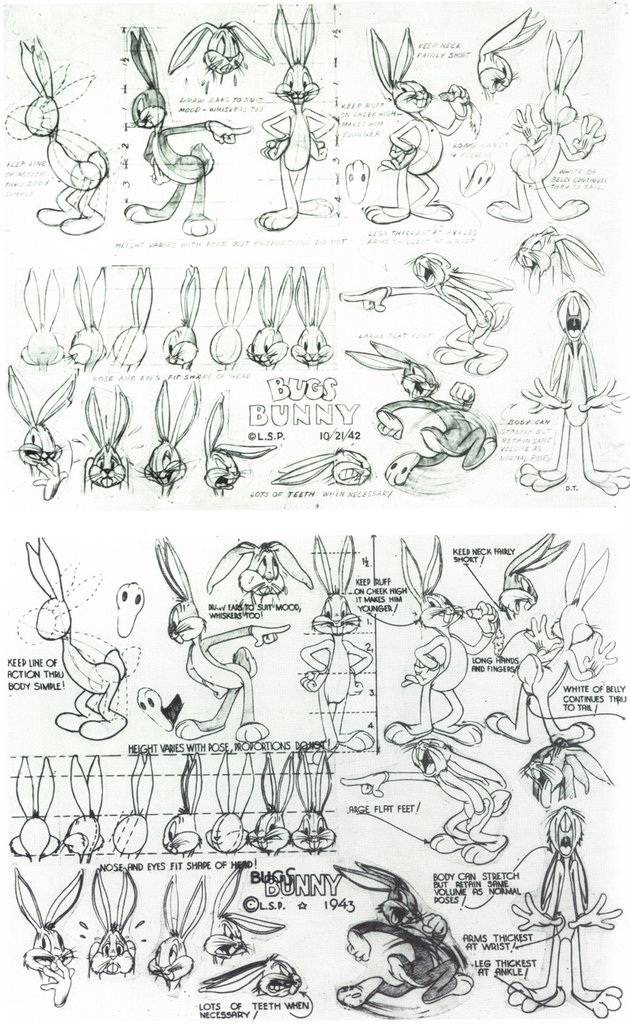
2. Create model sheets for the 20 or so key characters. For your information, here's what a model sheet looks like for one famous cartoon character.
I need to nail down what each character looks like in various poses. Those model sheets will "force" me to be consistent as I draw the final draft, "force" me to clarify the appearance, facial expressions, and stature of each student (and Dr. Q and the aliens), and "force" me to slow down. I'm eager to tackle inking/coloring but I MUST hone the penciled roughs first. Once those characters are fleshed out then....
3. Print hard copies of the polished, edited, and "finished" (will I ever "finish?" I'm constantly tweaking) pages (which will probably end up growing from 35- 45 pages) of dialog in Publisher on card stock.
4. On that card stock I'll sketch with pencil the characters, setting, interior of the classroom and space ship, folds in clothing, props, costume, and visual details. Here's an exquisite pencil "rough" from MAD artist Tom Richmond. Here's a link to his fabulous web/blog.
5. Ink the penciled rough in black. Here's the above drawing "inked."
Using Tom Richmond as my inspiration is a fool's errand; he's the industry standard for cool, creative, and technically savvy. I am but a lowly left-handed Norwegian therapist/skeptic/theist prone to melancholy. Nevertheless, my motto is: "shoot for the moon; you may hit the fence."
6. Once "inked" I'll re-scan the pages into a digital format on a yet to be purchased gadget (Adobe Illustrator? Corel Draw? Bamboo Tablet?) and color it. Here's Tom's finished cover.
Having never created digital art before there's going to be a massive learning curve (do these technical learning curves ever stop?). But my goal is to draw the old fashioned way and then color and shade on a tablet. The class I took last February with Jason Seilor was digital and mind blowing. (I was born 40 years too early to "get" digital life but if Ecclesiastes 3 is correct it was meant to be). Those posted pages will be a new and improved First Draft but behind the scenes I'll call that Draft Six.
7. Once pages 1-45 (Ecclesiastes 1 & 2) are complete I'll slowly post them for First Readers to scrutinize, evaluate, and critique.
8. Unless audience feedback is entirely negative I'll then revert to adding new "rough sketches" for the remainder of the book for First Reader feedback. I can produce rough drafts faster than inked/colored drafts and want the entire book to be semi public before I ink/color the finished work.
As mentioned before, the reason I'm inking/coloring pages 1-45 before re-posting them is to introduce First Readers to the alien narrators with as much visual verve as possible. I'll unveil them with fear and trembling; if they "work" I'll receive a major deposit in my enthusiasm bank. If feedback is negative it'll be a huge withdrawal and completion will be laborious.
From this vantage point I'm determined to complete this work sometime in 2013. If the feedback is lackluster I'll grit my teeth and still produce a work of art that others ignore. I'm determined to finish this graphic novel regardless of audience appreciation. Some of my biggest heroes are those who forged ahead when popular opinion was against them--Galileo, Kafka, Dickenson, Van Gogh, Col. Sanders, and Henry Dargar. My book will hardly revolutionize cosmology, existentialism, poetry, painting, chicken, or illustrated novels, but again, shoot for the moon....
Friday, August 17, 2012
I Dreamed of a Narrator for Ecclesiastes University
Once I hit the pause button to rethink the structure of this book my conscious mind went numb, "How do I integrate the helpful comments from my first readers without starting from scratch?" Thankfully, my subconscious mind did not quit working.
I dreamed I invented a narrator, a new main character, who spoke in the first person to a therapist about his depression. He showed the therapist his “notes” which were the comic strip pages already drawn. I drew the narrator's thumb on the right side of the pages holding the comic book for his therapist to read. I also inserted snap shot drawings of the students like when someone takes a photo in a movie and the picture freezes and turns momentarily to black and white. I was freed from strict linearity and could time travel with ease. It was quite liberating, actually.
This dream was also disconcerting because I was trying to do math in my sleep…how can I add pages/panels with as little re-editing as
possible? Each day lecture needs an even number of pages, and I CAN’T
disassemble each Publisher Page and relocate the existing word balloons.
Random Thoughts about Narration
Currently, there is no narrator. Readers listen in on the images/dialog that some unnamed person (the cartoonist) provides. An invisible entity chooses camera angles, what to leave out between panels, who says what, etc. I think this is what tires readers. They are borne along with little time to breathe during the journey. A narrator would (if my dream was correct) assist readers in plot.
A narrator talking to a therapist is too 1960s and Woody Allen-ish.
Who was the narrator is Metamorphosis? "As Gregor Samsa awoke one morning from uneasy dreams he found himself transformed in his bed into a gigantic insect-like creature."
Are narrators omniscient? They must be in order to convey the plot to the audience. Wiki says,
"The narrator may be a fictive person devised by the
author as a stand-alone entity, or may even be a character. The narrator is
considered participant if an actual character in the story,
and nonparticipant if only
an implied character, or a sort of omniscient or semi-omniscient being who does
not take part in the story but only relates it to the audience."
I need a narrator who is not enveloped by Dr. Q's philosophical musings.
Some narrator options
- a demon “taking photos” of each character rooting for skepticism, doubt, atheism, and/or nihilism to take over.
- an angel “taking photos” rooting for faith/hope/love to take over.
- a hapless student (not me) musing about depression
- a hapless student (me) musing about depression
- God
- Fly on the wall
- Alien
- Solomon
The narrator could
“reflect” at the end of each day’s lecture/riffs. If the joke was stupid he
could say so. His “stance” would be objective. Unlike the students who whine
about Dr. Q’s repetition and gloominess, the objective narrator could respond
logically and clearly, without emotion.
Narrators narrate, but to whom is my narrator speaking?
Readers, of course, but are the panels then supportive documentation for his monologue? If so, fine.
But how then do I segue into the classroom pages? In other words, what is the
narrator saying that would lead him to “show” students talking?
I'm wary of adopting a Screwtape plot; Lewis gets the credit for that bit of brilliance. Plus, I don’t want to bludgeon readers with supernatural-ism, demonic or otherwise.
Do omniscient narrators ever show emotion?
Voice-over while images zoom in from outer space into classroom
(thanks, Google maps).
Given the fact that 428 Publisher pages have been set up with thousands of dialog boxes tediously put in place and filled with correct font and text, I can’t have the
narrator insert his (her, its) voice into an individual page. He/she/it can only speak
before and after each day.
But this poses another huge problem….what possibly
can the narrator say that would fill up an entire page?
I could invent a new student whom the narrator watches outside of class and makes comments about….or the narrator could observe and make comments about all the students. Perhaps the narrator could comment on several of the characters between classes. I can almost visualize a second “plot” outside of the classroom.
Does
the narrator have access to the character’s mind? I the cartoonist have access to the classroom lecture
complete with sound and visuals. I’m enabling viewers to eavesdrop on a
classroom. I do not have access into the psyche of any student (other than any
conclusions we draw from attire, vocabulary, reactions, etc). Perhaps an omniscient narrator would know what students are thinking.
Does the narrator observe Dr. Q between classes? That would
be fun speculation but I’m afraid I'd contaminate the pure text of Eccl
with fiction. My main characters are
the students who listen and react to Dr. Q’s lecture.
A narrator could make the narrative flow more explicit.
He/she/it could turn those talking heads into real persons with whom the
audience could (hopefully) relate. The narrator would "model" for readers curiosity, interest, tedium, astonishment, empathy, etc.
The narrator could show the pictures and biography of each
student like Base Ball Cards.
Narrator in the tone of Rod Serling: “Observe one Karenoia, plagued by OCD, and anxiety- reducing rituals. She thought her life was manageable ... until she
entered Ecclesiastes University [the Twilight Zone].”
The narrator could end each of his/her/its comments with,
“Day one.” But 50 times? Yikes. Perhaps I could reduce the number of days/lectures
by combining them (stretching same color over many pages).
ALIEN DIALOG
Setting: inside space ship
Characters: two aliens, father and son
Plot: son taking dad on outing for bonding (dad agreed to
let son chose the activity)
What planet are they from?
How old are they?
How’d the son know so much about earth?
How could this ever be turned into a stage play?
Thursday, July 26, 2012
Random Observations about Cartooning
With as much effort as I'm putting into this graphic novel the thought has occurred to me more than once, "Buy a computer soft ware art program for the finished product." It's not the $600 price tag that deters me, it's the learning curve. Drawing on a tablet just doesn't seem right to this old time ink-slinger. Yet, the colored pencils and colored markers I've been using look terrible. Granted, I'm knocking out talking heads at this point rather hastily simply to give the dialog a mouth from which to emanate. But the Platonic graphic novel in my head looks much better than the way Draft 5 looks on the screen or on hard copy.
I just finished page 33 (66 half pages). The changing background color is working for me....but I've yet to crack the following problems:
- How do I help readers keep the many characters clear? At least I haven't given them Russian names. I actually haven't given them any names in the text yet. Do I add a "Cast of Characters" page? If so, up front or in an appendix? Or sprinkled throughout the text when they each make their first appearance?
- Do I need a background? All those photos of the university class room may be pointless since the talking heads take up almost the whole panel.
- What will sustain readers' interest? It seems at this point only a very dedicated student of Ecclesiastes would stay focused. Everyone else's eyes will glaze over given the monotonous repetition of panels, layout, and talking heads.
- Do I cite references, days, name of lecture? I do on the blog where I'm posting the rough draft (click HERE). But readers of the final product will not have access to additional factoids.
- Is there a way I can leverage 2000 talking heads to my advantage? Rather than trying to break up the monotony with a sly inclusion of field trips, long shots, Power Point and lap top screen images (pretending that 2000 talking heads in a comic book is normal), maybe I can claim the talking heads as my raison d'etre. I'm not interested in changing the name Ecclesiastes University, but maybe I can add a tag line letting readers know I'm including 2000 talking heads on purpose, with artfulness, and with existential intention. Now to come up with such a tag line: 49 University Students Recoil from a Socratic Cattle Prod, Ancient Existentialism Unleashed on One Hundred Fertile Cerebrums, or, Be Glad I Didn't Draw Each Synapse. I'll keep working on it.
The pace of production is slow, slow, slow. But it's a zen-like, pleasant slow. I doodle alone in this big house sans five kids and loving wife. I'm somewhat astonished that I can sit in silence (apart from the melodic noise of our neighbors chickens and horses) for five hours scribbling, inking, scanning, and uploading. If I were under an editor's deadline I'd be in big trouble. But as it is I'm progressing at a pace that fits my work load, energy load, and interest load.
Which raises this important question: is there rhyme or reason to the ebb and flow of one's focus? For the first time since last December, earlier this week I spent two days not working on Ecclesiastes University. I wasn't depressed (I don't think), bored, or passionless about this project. I watched TV, Netflix, read good books, cleaned the house, washed clothes, went to work. But I couldn't muster the oomph to put lines on paper. If I knew what factors deterred me from productive labor I'd know what to avoid.
That facial expression book I bought a while back is helpful. As are the reference photos I've been taking of hands, body language, etc. I don't draw from nothing; I use reference materials.
I perused a collection of a reprinted newspaper comic strip called Foxtrot. It's consistently funny in 4 black and white panels. It's hard for me to be objective about my humor since my humor-o-meter is distracted with the other meters against which I am constantly measuring myself: philosophy, character development, drawing facial expressions, and many more. My First Readers are giving consistent feedback that my book is not funny and I believe them. It's in my mind to rework the dialog once I complete Draft Five: inserting jokes into a narrative flow will be easier than adjusting the narrative flow around the jokes. Or so I tell myself.
![]() |
| Detail, page 29 |
I cut and pasted friend Mark's old caricature here which is illustrative of the style of drawing I anticipate using in the final draft. It also demonstrates why I'm so unhappy with the rough cartoons I'm using in Draft Five. I'm working with drawings that are only weak approximations of what I envision the finished product to look like. But even with shaded caricatures like this I'm not sure good drawings are enough to sustain readers' attention. I'm zealous to write dialog that is sterling in its own right, the addition of well crafted drawings only adding value.
No wonder my lawn gets mowed so infrequently...I'm obsessed with this project.
Thursday, July 5, 2012
Talking Heads....blah, blah, blah
Take a gander at the book so far (in miniature). I am unhappy with what I see. Too many talking heads. All I see are talking heads! Either I'm going to invent a cutting edge, new type of graphic novel--talking heads as metaphor for the meaninglessness of life--or I've got to liven up the set.
| Imagine 100 students all looking bored. |
| The artist contemplating the tedium of talking heads. |
| I can't wait to fill these chairs with my cast of characters....but for 200 pages? Yikes, I'm toast. |
My first thought is, "This is impossible! How will adding inert desks improve the action?!"
Brains are wired to solve problems and I've got a big problem....how do I increase the importance of the graphics in this graphic novel? My, my, my. This is a difficultly of Biblical proportions.
Tuesday, July 3, 2012
Draft Five pages 6-10
Sunday, July 1, 2012
Draft Five, pages 1-5
With great joy I introduce for the very first time pages 1-5 of Draft Five of Ecclesiastes University.
There are many changes begging to be made...not only in the heads (too big) but also in the scanning (too dark), pagination (too small), color (absent in background; once added the word balloons will pop out in stark contrast), word balloon tails (for all my weeks of tweaking I still must re-position the little gap where I'll attach the tail--dread!), camera angle (too many close ups; I want students walking around at some point), character design (these drawings are the first of hundreds and I suspect we'll sharpen, simplify, and hone their features as we go), setting (no walls, desks, or props), and more.
I visualize what the final art will be and a part of me wishes I could show readers the finished product. But I dare not invest that much time on a final draft which no one but me has seen. I don't trust myself; I need others' input before putting the finishing touches on Draft Six.
Putting this together was bliss...yet I feel a twinge of anxiety about sending this to my first readers. Why? Their mission will be to evaluate the script; I fear their eye gate will take precedence over their text editing lobes. I suspect these drawings will solicit a dozen comments for improvement but it's the words I want them to evaluate.
This is the first day (Eccl. 1:1-8a). In the next thought unit the characters will have different clothing, seating arrangement, and background color.
Of the nine characters I've introduced in this first installment, two will drop out and of those that remain all will be influenced (for good and ill) by Dr. Q's lectures.
Subscribe to:
Posts (Atom)