Showing posts with label criticism. Show all posts

Sunday, March 3, 2013

Page 4a


As I drew this half page all the voices of all the writing instructors, books, and coaches I've ever had screamed in my head, "Show, don't tell!" I scream back, "I don't have time. Shut up." My attitude is a less than perfect finished manuscript is better than a perfect unfinished one. Right or wrong, this is the creative path I've chosen. This somewhat simple page took only 2 hours; my speed is increasing. Yay.

Saturday, September 1, 2012

Project Management

Working my way out of the quagmire I got myself into requires outlining my project's next tasks step by step. Here's my outline (subject to adaptation if necessary). Before posting any new pages on my other blog (click here) I need to complete the following tasks.

1.  Continue to write/insert new narrator rough draft pages in the first 35 pages (which comprises  Ecclesiastes 1 & 2). Those pages comprise what I've been calling Draft 5 (but viewers of that other blog know only as the first draft). I've yet to find the narrators' voice, father and son alien observers of Ecclesiastes University. They riff on the students' riffs on Dr. Q's lecture. It adds a layer of complexity AND clarity. Somebody's got to make sense of what those students are jabbering about. Once I've caught up to page 35 it's time to....

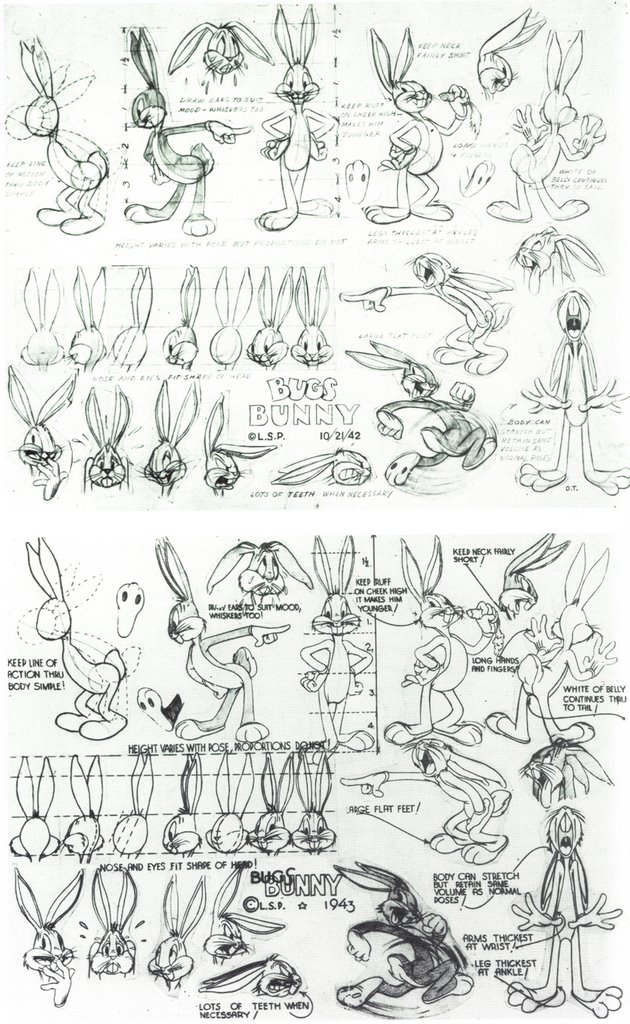
2.  Create model sheets for the 20 or so key characters. For your information, here's what a model sheet looks like for one famous cartoon character.


I need to nail down what each character looks like in various poses. Those model sheets will "force" me to be consistent as I draw the final draft, "force" me to clarify the appearance, facial expressions, and stature of each student (and Dr. Q and the aliens), and "force" me to slow down. I'm eager to tackle inking/coloring but I MUST hone the penciled roughs first. Once those characters are fleshed out then....

3. Print hard copies of the polished, edited, and "finished" (will I ever "finish?" I'm constantly tweaking) pages (which will probably end up growing from 35- 45 pages) of dialog in Publisher on card stock.

4. On that card stock I'll sketch with pencil the characters, setting, interior of the classroom and space ship, folds in clothing, props, costume, and visual details. Here's an exquisite pencil "rough" from MAD artist Tom Richmond. Here's a link to his fabulous web/blog.


5. Ink the penciled rough in black. Here's the above drawing "inked."


Using Tom Richmond as my inspiration is a fool's errand; he's the industry standard for cool, creative, and technically savvy. I am but a lowly left-handed Norwegian therapist/skeptic/theist prone to melancholy. Nevertheless, my motto is: "shoot for the moon; you may hit the fence."

6. Once "inked" I'll re-scan the pages into a digital format on a yet to be purchased gadget (Adobe Illustrator? Corel Draw? Bamboo Tablet?) and color it. Here's Tom's finished cover.


Having never created digital art before there's going to be a massive learning curve (do these technical learning curves ever stop?). But my goal is to draw the old fashioned way and then color and shade on a tablet. The class I took last February with Jason Seilor was digital and mind blowing. (I was born 40 years too early to "get" digital life but if Ecclesiastes 3 is correct it was meant to be). Those posted pages will be a new and improved First Draft but behind the scenes I'll call that Draft Six.

7. Once pages 1-45 (Ecclesiastes 1 & 2) are complete I'll slowly post them for First Readers to scrutinize, evaluate, and critique.

8. Unless audience feedback is entirely negative I'll then revert to adding new "rough sketches" for the remainder of the book for First Reader feedback. I can produce rough drafts faster than inked/colored drafts and want the entire book to be semi public before I ink/color the finished work.

As mentioned before, the reason I'm inking/coloring pages 1-45 before re-posting them is to introduce First Readers to the alien narrators with as much visual verve as possible. I'll unveil them with fear and trembling; if they "work" I'll receive a major deposit in my enthusiasm bank. If feedback is negative it'll be a huge withdrawal and completion will be laborious.

From this vantage point I'm determined to complete this work sometime in 2013. If the feedback is lackluster I'll grit my teeth and still produce a work of art that others ignore. I'm determined to finish this graphic novel regardless of audience appreciation. Some of my biggest heroes are those who forged ahead when popular opinion was against them--Galileo, Kafka, Dickenson, Van Gogh, Col. Sanders, and Henry Dargar. My book will hardly revolutionize cosmology, existentialism, poetry, painting, chicken, or illustrated novels, but again, shoot for the moon....


Friday, August 17, 2012

I Dreamed of a Narrator for Ecclesiastes University

Once I hit the pause button to rethink the structure of this book my conscious mind went numb, "How do I integrate the helpful comments from my first readers without starting from scratch?" Thankfully, my subconscious mind did not quit working. 

I dreamed I invented a narrator, a new main character, who spoke in the first person to a therapist about his depression. He showed the therapist his “notes” which were the comic strip pages already drawn. I drew the narrator's thumb on the right side of the pages holding the comic book for his therapist to read. I also inserted snap shot drawings of the students like when someone takes a photo in a movie and the picture freezes and turns momentarily to black and white. I was freed from strict linearity and could time travel with ease. It was quite liberating, actually.

This dream was also disconcerting because I was trying to do math in my sleep…how can I add pages/panels with as little re-editing as possible? Each day lecture needs an even number of pages, and I CAN’T disassemble each Publisher Page and relocate the existing word balloons. 

Random Thoughts about Narration

Currently, there is no narrator. Readers listen in on the images/dialog that some unnamed person (the cartoonist) provides. An invisible entity chooses camera angles, what to leave out between panels, who says what, etc. I think this is what tires readers. They are borne along with little time to breathe during the journey. A narrator would (if my dream was correct) assist readers in plot.

A narrator talking to a therapist is too 1960s and Woody Allen-ish.

Who was the narrator is Metamorphosis? "As Gregor Samsa awoke one morning from uneasy dreams he found himself transformed in his bed into a gigantic insect-like creature."

Are narrators omniscient? They must be in order to convey the plot to the audience. Wiki says, 

"The narrator may be a fictive person devised by the author as a stand-alone entity, or may even be a character. The narrator is considered participant if an actual character in the story, and nonparticipant if only an implied character, or a sort of omniscient or semi-omniscient being who does not take part in the story but only relates it to the audience."
I need a narrator who is not enveloped by Dr. Q's philosophical musings. 
Some narrator options
  • a demon “taking photos” of each character rooting for skepticism, doubt, atheism, and/or nihilism to take over. 
  • an angel “taking photos” rooting for faith/hope/love to take over.
  • a hapless student (not me) musing about depression
  • a hapless student (me) musing about depression
  • God
  • Fly on the wall
  • Alien
  • Solomon

The narrator could “reflect” at the end of each day’s lecture/riffs. If the joke was stupid he could say so. His “stance” would be objective. Unlike the students who whine about Dr. Q’s repetition and gloominess, the objective narrator could respond logically and clearly, without emotion.

Narrators narrate, but to whom is my narrator speaking? Readers, of course, but are the panels then supportive documentation for his monologue? If so, fine. But how then do I segue into the classroom pages? In other words, what is the narrator saying that would lead him to “show” students talking? 

I'm wary of adopting a Screwtape plot; Lewis gets the credit for that bit of brilliance. Plus, I don’t want to bludgeon readers with supernatural-ism, demonic or otherwise.  

Do omniscient narrators ever show emotion?

Voice-over while images zoom in from outer space into classroom (thanks, Google maps).

Given the fact that 428 Publisher pages have been set up with thousands of dialog boxes tediously put in place and filled with correct font and text, I can’t have the narrator insert his (her, its) voice into an individual page. He/she/it can only speak before and after each day. 

But this poses another huge problem….what possibly can the narrator say that would fill up an entire page? 

I could invent a new student whom the narrator watches outside of class and makes comments about….or the narrator could observe and make comments about all the students. Perhaps the narrator could comment on several of the characters between classes. I can almost visualize a second “plot” outside of the classroom.

Does the narrator have access to the character’s mind? I the cartoonist have access to the classroom lecture complete with sound and visuals. I’m enabling viewers to eavesdrop on a classroom. I do not have access into the psyche of any student (other than any conclusions we draw from attire, vocabulary, reactions, etc). Perhaps an omniscient narrator would know what students are thinking.

Does the narrator observe Dr. Q between classes? That would be fun speculation but I’m afraid I'd contaminate the pure text of Eccl with fiction.  My main characters are the students who listen and react to Dr. Q’s lecture.

A narrator could make the narrative flow more explicit. He/she/it could turn those talking heads into real persons with whom the audience could (hopefully) relate. The narrator would "model" for readers curiosity, interest, tedium, astonishment, empathy, etc.

The narrator could show the pictures and biography of each student like Base Ball Cards.

Narrator in the tone of Rod Serling: “Observe one Karenoia, plagued by OCD, and anxiety- reducing rituals. She thought her life was manageable ... until she entered Ecclesiastes University [the Twilight Zone].” 

The narrator could end each of his/her/its comments with, “Day one.” But 50 times? Yikes. Perhaps I could reduce the number of days/lectures by combining them (stretching same color over many pages).     


ALIEN DIALOG

Setting: inside space ship
Characters: two aliens, father and son
Plot: son taking dad on outing for bonding (dad agreed to let son chose the activity)

What planet are they from?
How old are they?
How’d the son know so much about earth?
How could this ever be turned into a stage play? 


Thursday, August 2, 2012

Status Update

Thirty-five pages of rough draft number five have been posted on the other site for first readers to scan and comment upon. The feedback has been so helpful I've hit the pause button to rethink the whole premise of this graphic novel. 2000+ talking heads are just too boring. So what are my options?

Make the claim that the boredom is an intentional literary device to further illustrate the message of vanity, absurdity, and pointlessness. This is a bit disingenuous, like the guy who shoots his bow wildly and then draws targets around randomly shot arrows.

Scrap the whole thing and write a stage play or screen play. No more graphic novel? Ouch.

Scrap Ecclesiastes and go mow my lawn. And give up philosophical ruminations? Double ouch.

Reformat the whole thing:

  • give students only 2 panels (delete the second row of 1-3 boxes) to riff on Dr. Q. This would essentially cut the book--and boredom--in half. Less is more, but that much less?
  • enlarge the size of my printed hard copy thus giving me a larger drawing space in which to draw settings, props, action, etc. This would essentially render my existing 428 pages null and void...after all that work!
  • put new words into Dr. Q's mouth; fictionalize him. This would make the finished product "based upon the book of Ecclesiastes" rather than "taking every word of the ancient text as is and seeing it crash against modern thinking."
  • keep the format but reduce the number of characters. Theoretically I could cut the number of students in half, combining various traits into one. This would cut down the confusion of who's who but increase confusion about student motives. Currently each student represents one philosophical/emotional point of view. Blending them would make each character complex and self contradictory. Plus, I might get bored with the few students that remain. I like the variety of a huge cast of characters.
  • press on hoping readers will eventually identify with the individual characters. This is risky because there is no glue currently keeping readers engaged. Even with spiffed up drawings I suspect the insipid dialog will be lethal. Death by word balloon.
  • increase the wit and wisdom of student comments. When I read a really good book I hang on every word, dreading the end. I want it to keep on going. Here's where fantasy crashes against reality. I just don't have the synaptic chops to charm audiences like Steve Martin, Woody Allen, David Sedaris, Dave Barry, Mark Twain, Tina Fey, Robert Benchley, S J Pereleman, Bill Bryson, Daniel Gilbert, Soren Kierkegaard (he knocked 'em dead in Denmark), or (insert name here). 
  • press on and hope to find readers with low expectations. Surely in a planet of 7 billion somebody, somewhere likes bad puns, angst overkill, and talking heads.
  • abandon audience approval entirely and write the book I wish I had in college. In a later post I'll reproduce some cartoons I drew while at UW '79-'81.
  • gamble my reputation on good drawings justifying boring text. This is a huge gamble and I'm notorious for losing gambles. Want proof? My closets are full of manuscripts, wheels, drawings and self published books that failed to garner audience interest. I killed a small forest trying to get traction as a purveyor of peace making comics, sapiential psychology, and mixed metaphors. 
  • change my audience. Instead of modern college students perhaps I should aim to connect with fundamentalists. Ecclesiastes is in their book and my graphic novel would call attention to and validate its message. This, however, may prove the hardest sell of all because fundamentalists are disinclined to grapple with randomness, failed theodicies, and the puncturing of tidy systematic theology. Nobody likes to be told the king has no clothes or that Pollyanna providence is a myth. 
I have to leave for work soon so must end this problem solving musing. My inner optimist believes that there is an answer to this somewhere, I just haven't found it yet. I'll mull over these options and see which sticks. 

Thursday, July 19, 2012

Ten Observations about Creativity and Distraction

Before launching a new blog where I'm posting the first rough draft to go public I wondered how that new endeavor might affect my creativity. Here's what I've learned.

1.  A significant portion of my brain is now hooked on feedback. Rather than blissfully creating with nary a care, I spend a considerable amount of time hoping for, anticipating, and wishing for feedback.

2.  Once I get that welcome feedback I then spend considerable time answering. Both wishing for and responding to feedback takes away from drawing.

3.  I also spend time integrating that feedback into the pages I've completed. That is, I'm now editing those first pages incorporating the great suggestions First Readers have offered. This too takes away time from penciling, inking, and posting that public rough draft.

4.  While I miss time away from drawing I must admit my ADD prone brain doesn't mind juggling all these disparate tasks. Part of the message of Ecclesiastes is that variety is the spice of life and engaging with the public over these doodles certainly adds variety.

5.  Knowing that I've now got followers on that other blog (I think about 10 of the 30 I invited) I feel additional motivation to keep on top of my self imposed posting schedule. I'm aiming for two posts per week. I'd like to do more but turning my latest rough draft into a printable rough draft is still agonizingly slow. I'm just trying to cram too much data (pencil layouts, character development, more tweaking of the dialog, inking, coloring) through too small a pipe (my brain).

6.  Posting this very rough draft feeds my sub personalities which are already prone to shame, embarrassment, and discouragement. The work in progress is a fool's errand. Each of the ingredients (humor, layout, facial expressions, section divisions, dialog, etc) are sub par and painful to read. Thus, a considerable amount of psychic time is spent fighting those self critical parts and pushing through the wall of resistance to accomplish the task at hand--illustrate the whole book of Ecclesiastes.

7.  I'm "forced" to continually dangle in front of my imagination the Platonic arch-type of a polished, finished, and honed final product. In my mind it "works." It's witty. It's unique. It's helpful. It's drawn to perfection. Readers get it. Theologians, philosophers, and depressed existentialists welcome it. This fantasy is shamed by reality--what I've posted so far falls way short of this ideal. It looks to me garish, confusing, halting, insipid, and the work of a deranged mind. Oh well. There is a perfect graphic novel based on Ecclesiastes in essence somewhere in the universe and my efforts will bring it into existence.

8.  I frame this psychic battle in positive terms. Moderating the internal debate builds character, strengthens synapses, and to be frank, is fun. Like the gambler whose dopamine neurotransmitters flow like Niagara when tossing dice, anticipating the finished product keeps my brain chemicals in a nearly constant state of mental bliss.

9.  Posting the rough draft reveals many new problems to be solved. How do I conquer the tedium of boring talking heads? How do I help readers distinguish one character from another? How do I color the thing so it looks pleasing and not so childish? How do I elevate the humor? Will the overall effect of student reactions bring clarity to readers' minds about matters of faith, existentialism, and suffering? When do I invite more First Readers? Should I invite more First Readers? These challenges distract me from the drawing task at hand but they are a pleasant distraction.

10.  Inviting a tiny slice of the public to evaluate these pages forces me to define success. If writing like Tina Fey is my goal, I've failed. If drawing like Herge is my goal, I've failed. If musing like Kierkegaard, Pascal, Dostoevsky is my goal, I've failed. If creating a work that goes viral is my goal, I've failed. If creating scenes, settings, and camera angles like Steven Spielberg is my goal, I've failed. If winning a Pulitzer like Art Spiegelman is my goal, I've failed. But if marshaling and merging dozens of tasks from my fevered brain to create a hefty existential comic book and having fun while doing so is my goal, I'm king of the hill, a gold medal winner, I get the yellow jersey, Heisman trophy, and lifetime membership in the hall of fame.

Saturday, July 14, 2012

The Joy of Feedback

NOTE: Now that rough pages are being posted for public review elsewhere (click HERE) I will continue to use this blog to muse about the process. Why keep these comments separate from the other blog? I want readers of that other blog to put their energy into critique of the product, not get blogged down in the process. This is the place to get blogged down in the process!


Professional graphic novels involve specialists:


writers
editors
pencilers
inkers
letterers
layout
camera angle
colorists
humorists
casting
dialog coaches
costume
cover art
setting
props
continuity
philosophy/theology
scanning/uploading 
and more.


Since I'm an amateur doing each of these tasks I'm setting myself up for harsh criticism. Pick any one of those tasks and compare my work to the work of pros and I'm toast. What will keep me optimistic even in the face of likely negative feedback? 


1.  my task-cluttered brain overlooks a zillion glaring mistakes, omissions, and gaffs. Clear eyed critique from others will help me see those mistakes and suggest improvements.


2.  The computer that beat Garry Kasparov at chess could not play backgammon. The computer that beat the world backgammon champ could not play chess. The human brain loses chess and backgammon when pitted against specialized computers. However, no computer can multitask like a human. Not only can we play chess and backgammon simultaneously, we can sing, cook, love, and do a zillion other things machines can't. Thus, when my skills as writer, inker,  etc. are compared to pros I know I fall short. But ask any random person to complete all of the above tasks and odds are they'd not come up with 428 pages of stuff. 


3. I feign no illusion of greatness. What I lack in quality I make up for in quantity. While I'd rather come up with 10 pages of brilliance rather than 400+ pages of piffle, I'm content to crank out what I crank out. Mediocre is better than nothing.


4.  Woody Guthrie has been quoted, "I write 1000 songs in the hopes that one or two of them will be good ones." I concur. I crank out volumes of stuff in hopes that one or two items may have merit on the scale of Washington's state song by Guthrie, "Roll On Columbia."


5. Einstein is credited with the following quote, Everybody is a genius. But if you judge a fish by its ability to climb a tree, it will live its whole life believing that it is stupid.” One can either reinforce a negative self image by judging one's self by what they can't do (write like CS Lewis, draw like Albrecht Durer, beat Deep Blue at chess), or take comfort in what they can do (a bunch of things at once).


6.  My success won't be measured in book sales but the bliss of creating. So by that criteria I've been successful for a long time. 

So with these thoughts in mind bring on the critique, I'm ready!