Showing posts with label writing process. Show all posts

Sunday, March 3, 2013

Page 4a


As I drew this half page all the voices of all the writing instructors, books, and coaches I've ever had screamed in my head, "Show, don't tell!" I scream back, "I don't have time. Shut up." My attitude is a less than perfect finished manuscript is better than a perfect unfinished one. Right or wrong, this is the creative path I've chosen. This somewhat simple page took only 2 hours; my speed is increasing. Yay.

Sunday, September 16, 2012

Milestone Reached

Just completed the new Draft Five. What previously had been 35 pages has grown to 53 pages (106 half pages in Publisher). I've added two narrators (space aliens) who eavesdrop on the class and comment not unlike these quipping pop culture icons:
Mystery Science Theater 3000

Muppets Two Old Men

Furthermore, I've isolated 22 main characters and have given them names, ages, majors, motivations, and philosophical orientations. It's like I'm playing chess while simultaneously inventing the pieces and the moves they make. I've created these 22 characters and turned them loose to listen to Dr. Q jabber on and on about life's futility.


So now, at long last, I begin the delicious task of making model sheets. I'm fighting the temptation to buy my Bamboo Tablet yet. I'll tackle this next stage of the journey with old fashioned paper and pencil. 

Saturday, September 1, 2012

Project Management

Working my way out of the quagmire I got myself into requires outlining my project's next tasks step by step. Here's my outline (subject to adaptation if necessary). Before posting any new pages on my other blog (click here) I need to complete the following tasks.

1.  Continue to write/insert new narrator rough draft pages in the first 35 pages (which comprises  Ecclesiastes 1 & 2). Those pages comprise what I've been calling Draft 5 (but viewers of that other blog know only as the first draft). I've yet to find the narrators' voice, father and son alien observers of Ecclesiastes University. They riff on the students' riffs on Dr. Q's lecture. It adds a layer of complexity AND clarity. Somebody's got to make sense of what those students are jabbering about. Once I've caught up to page 35 it's time to....

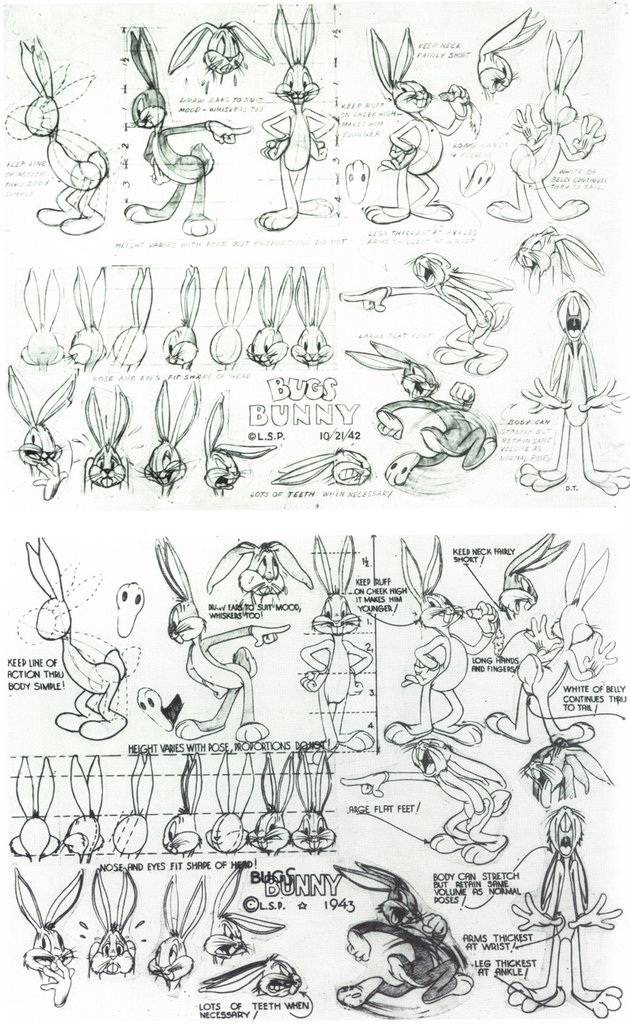
2.  Create model sheets for the 20 or so key characters. For your information, here's what a model sheet looks like for one famous cartoon character.


I need to nail down what each character looks like in various poses. Those model sheets will "force" me to be consistent as I draw the final draft, "force" me to clarify the appearance, facial expressions, and stature of each student (and Dr. Q and the aliens), and "force" me to slow down. I'm eager to tackle inking/coloring but I MUST hone the penciled roughs first. Once those characters are fleshed out then....

3. Print hard copies of the polished, edited, and "finished" (will I ever "finish?" I'm constantly tweaking) pages (which will probably end up growing from 35- 45 pages) of dialog in Publisher on card stock.

4. On that card stock I'll sketch with pencil the characters, setting, interior of the classroom and space ship, folds in clothing, props, costume, and visual details. Here's an exquisite pencil "rough" from MAD artist Tom Richmond. Here's a link to his fabulous web/blog.


5. Ink the penciled rough in black. Here's the above drawing "inked."


Using Tom Richmond as my inspiration is a fool's errand; he's the industry standard for cool, creative, and technically savvy. I am but a lowly left-handed Norwegian therapist/skeptic/theist prone to melancholy. Nevertheless, my motto is: "shoot for the moon; you may hit the fence."

6. Once "inked" I'll re-scan the pages into a digital format on a yet to be purchased gadget (Adobe Illustrator? Corel Draw? Bamboo Tablet?) and color it. Here's Tom's finished cover.


Having never created digital art before there's going to be a massive learning curve (do these technical learning curves ever stop?). But my goal is to draw the old fashioned way and then color and shade on a tablet. The class I took last February with Jason Seilor was digital and mind blowing. (I was born 40 years too early to "get" digital life but if Ecclesiastes 3 is correct it was meant to be). Those posted pages will be a new and improved First Draft but behind the scenes I'll call that Draft Six.

7. Once pages 1-45 (Ecclesiastes 1 & 2) are complete I'll slowly post them for First Readers to scrutinize, evaluate, and critique.

8. Unless audience feedback is entirely negative I'll then revert to adding new "rough sketches" for the remainder of the book for First Reader feedback. I can produce rough drafts faster than inked/colored drafts and want the entire book to be semi public before I ink/color the finished work.

As mentioned before, the reason I'm inking/coloring pages 1-45 before re-posting them is to introduce First Readers to the alien narrators with as much visual verve as possible. I'll unveil them with fear and trembling; if they "work" I'll receive a major deposit in my enthusiasm bank. If feedback is negative it'll be a huge withdrawal and completion will be laborious.

From this vantage point I'm determined to complete this work sometime in 2013. If the feedback is lackluster I'll grit my teeth and still produce a work of art that others ignore. I'm determined to finish this graphic novel regardless of audience appreciation. Some of my biggest heroes are those who forged ahead when popular opinion was against them--Galileo, Kafka, Dickenson, Van Gogh, Col. Sanders, and Henry Dargar. My book will hardly revolutionize cosmology, existentialism, poetry, painting, chicken, or illustrated novels, but again, shoot for the moon....


Friday, August 31, 2012

Story Boarding


Here are the first 16 pages. I'm inserting new pages of alien dialog into the previously posted 35 pages. It breaks up the talking head monotony only a wee bit.


I've tried a dozen different ways to break out of talking head format and failed. My creation is a wordy philosophical rumination and wordiness comes with the territory. Giving visual cues to who is ruminating requires me to draw heads. Many of them.

So, I'm back to my original ambition: draw those talking heads with pizzazz and verve. As I've edited the pages pictured above they've become rather sketchy and unsuitable for re-posting "as is" on the other blog for First Readers.

This creates another puzzle. When I introduce the alien narrators I'm afraid they'll be viewed as unwelcome kitsch unless I present the pages in full color and with full character development (model sheets). I'm constantly challenged to prevent the rough draft drawings detracting from story development.

If I buy the software and tablet for digital rendering now that'll require weeks if not months of learning new techie stuff which will distract from my current task: posting the rough draft for First Reader evaluation.

This poses a ton of new problems. 

How polished do I make the rough draft for public evaluation?
How long will it take to polish the first 35 pages?
Do I keep my original plan and print the Publisher pages of word balloons on card stock for pencil/ink line drawings to then be digitally colored?
Or do I try to learn how to draw them digitally?
If digitally, will the new software allow me to import 250 pages of Publisher?
If not, must I print and re-scan each page?
Once polished will First Readers subconsciously expect the remaining 200 pages of rough draft to look as polished?

One definition of creativity: throw yourself into a quagmire of complexity and then try to fight your way out.

Wednesday, August 29, 2012

Back to my Roots

It's been difficult to focus on my graphic novel this summer. Warm weather, yard work, family activities, and other sundry interests have conspired to reduce the frequency of blog postings. In addition, cranking out rough draft pages has slowed to a snail's pace. Revamping much of the premise of the work (alien narrators) hasn't helped, either. With the end of summer approaching it's time to gear up again for the delightful work of writing and drawing. For inspiration I'm rereading Ecclesiastes. Here are some random musings from chapters 1-7:

"Everything is meaningless" (1:2). I don't entirely agree with this statement; I find meaning in  friendships, family connections, learning, reading, helping people in my mediation/counseling practice, and more. But I am grateful Dr. Q was courageous enough to acknowledge that some things clearly are absurd. For starters, I'm the one with a misspent youth yet my virtuous wife is the one who contracts a debilitating disease. Absurd, absurd, absurd.

"Generations come and generations go" (1:4). The specter of death has haunted humanity since the beginning of time. For all the disagreement about the causes and consequences of death, we're all agreed: the grim reaper will devour all of us eventually. Even though life spans have lengthened considerably, we're all going to die. No wonder Ecclesiastes hasn't become a best seller.

"The eye never has enough of seeing" (1:8). Imagine if this were not so--the demand for new TV shows, movies, web sties, books, vacations, tours, and fashions would vanish. But the eye is never satisfied and therefore new visual content is produced every second.

"The more knowledge the more grief" (1:18). The modern explosion of knowledge has been matched by an explosion of anxiety, depression, fear, worry, despair, angst, and ennui. I often remind myself of the persons described in the New Testament, "always learning and never coming to the knowledge of truth" and "those who desire to get rich pierce themselves with many a pang." My appetite for learning is insatiable but the outcome is questionable. I simply learn how ignorant I am.

"Laughter is foolish" (2:2). This line doesn't stop me from laughing or making others laugh. But Dr. Q's point is well taken: at the end of the day is frivolity the best way to spend one's energy?

"What do I gain by being wise?" (2:15). For decades I've done my best to apply Hebraic and Christian wisdom to myself, family, and others. I'm happy to report that I, my family, and others have enjoyed many happy days. However, those happy days just as easily could be attributed to good luck, random events, the result of the law of large numbers, and the inevitable benefit of living in an affluent culture. The fact that wisdom has not been universally and predictably beneficial to one and all makes me question metaphysics. I like it that Dr. Q questions it as well.

"I must leave my things to the one who comes after me" (2:18). After my dad's death it was my unpleasant task to dispose of his belongings--tools, paintings, cameras, furniture, and more tools. The day of our auction was an Ecclesiastes day for me; people I never met drove off with glee at the tons of his belongs they got for a song; things my dad worked 80 years to collect, love, fix, clean, manage, move, store, and cherish. Makes me look at the cumber around my house--what stranger is gleefully going to drive off with my collection of volvelles, manuscripts, art work, and journals?

"Even at night his mind does not rest" (2:23). In a perfect universe we'd sleep through the night. Neither I nor Dr. Q live in a perfect universe.

"He has set eternity in the hearts of men" (3:11). Occam's Razor suggests positing a deity behind psychology is superfluous, cumbersome, and unnecessary. I know. I embrace Dr. Q's quote by faith, anyway. Logical positivists call such language poetry, unscientific, and invalid. I know. I embrace Dr. Q's affirmation by faith, anyway. New and old atheists call this belief superstitious. neanderthal, and hallucinatory. I know, I know. My passion for ethics, transcendence, and existential meaning could be a blip on my synaptic radar, a quirk of my DNA, and an unimaginative parroting of the culture I was born into. Okay, okay, I get it. But I choose to believe otherwise. I stand with Dr. Q (and several others) on this point.

"His friend can help him get up" (4:10). I'm astonished at how many cohabiting and married couples mess this up. Either one party is over accommodating or smothering, demanding or overly dependent, and they take turns being miserable. Key terms: pursuit, distancing, badgering, clamming up, aloof, preoccupied, lousy service, low tip, co created chaos. I am passionate about helping couples differentiate, get healthy, and merge lives in positive ways. Not, necessarily from a passion to "save marriage" or even to "reduce the divorce rates." I'm obsessed with this mission because we live in an enlightened, affluent, and educated world with MRIs, Mars probes, gene sequencing, SSRIs, smart phones, and Google, and yet 50% of couples still can't get happy together. What a puzzle!

"An old person is foolish if they no longer know how to take warning" (4:13). This cuts me to the quick because I'm warning averse. Not (I hope) because I'm stubborn, self righteous, or impervious to good advice. I'm simply inured to fear mongers, anxiety mongers, and cognitive distortion mongers who foster fear, worry, and panic. This is an age of anxiousness with warnings thick as flies. There's not a boy crying wolf; there's a whole media culture crying wolf. Lord, help me heed legitimate warnings, ignore stupid warnings, and know the difference.

"Stand in awe of God" (5:7). Fellow parishioners sing with passion, worship with enthusiasm, and  engage in church with fervency. I, however, merely stand during worship and sway several millimeters in each direction. I'm every worship leader's worst nightmare. I do not clap, belt out, chant, chirp, croon, harmonize, intone, lift up a voice, make melody, pipe, purr, resound, roar, serenade, shout, trill, troll, tune, vocalize, warble, whistle, or yodel. I do hum from time to time, however. 

"Who knows what is good for a person in life during their few and meaningless days?" (6:12). Answer? Fundamentalist preachers, paternalistic politicians, imperative control freaks, dogmatic pontificates, and advertisers. Other than that we're pretty much a live and let live society. 

"It is better to go to a house of mourning than a house of feasting" (7:2). In September we mark the one year anniversary of my dear wife's move into a nursing home. My daily visits are still emotional roller coaster rides for me. The infirm, ailing, and frail elderly are clear reminders of aging and death. I'm quickly disabused of imagining immortality on earth. Metaphors of mortality--smoke, grass, shadows--inspire wise and fruitful living. He who dies with the most love wins. 

"The end of a matter is better than its beginning" (7:8). Another reminder to keep chipping away at this project. It is, with several other endeavors, my life's work.

To be continued.

Wednesday, August 22, 2012

Creativity


If I was offered a creativity pill which would make me automatically and fabulously creative (inventive, athletic, or brainy), I’d contemplate taking that pill for five seconds. During those five seconds I’d fantasize about the praise I’d receive for being the world’s best artist/writer (inventor, ping pong player, genius). But after that brief reverie reality would set in. Such a pill would NOT garner praise; people would say, “He’s no great shakes; he just took a pill.” 

Furthermore, such a pill would rob me of the joy of focus. When I’m creating I’m hyper-focused and alert to ways to mold my creation into the perfect image I've got in my head. I collect drawings, jokes, anecdotes, quotes, and ideas that I believe will improve my creation. It’s fun! 

And finally, it’s not necessarily the finished product that drives creativity. It’s the process. It’s the evolution. It’s the improvement. That pill would enable me to create a perfect work of art (science, physical legerdemain, or theorem) immediately. Where’s the fun in that?

Paradoxically, inner demons sabotage my creative urge. The delirium of joy I experience when creating is buggered by delay, stalling, postponement, avoidance, and distraction. The demons responsible for this are 

1) Kierkegaard’s “purity of heart is to will one thing.” My brain wills one hundred things and sustained focus is difficult. 

2) Darwin’s “survival of the fittest.” Random mutations (new ideas) alter the evolution of my creation and the vestigial organs (old ideas) put up a terrible fuss. 

3) Heisenberg’s “uncertainty principle.” I get flooded with energies that pop in and out of existence and choosing which wave/particle to nab is somewhat arbitrary. I suffer from paralysis of analysis.

And yet, the creative urge propels me. Twenty years ago who would have dreamed of today’s new and exciting creations? Today is the day to write/draw/create that thing undreamed of by people twenty years hence.

Friday, August 17, 2012

I Dreamed of a Narrator for Ecclesiastes University

Once I hit the pause button to rethink the structure of this book my conscious mind went numb, "How do I integrate the helpful comments from my first readers without starting from scratch?" Thankfully, my subconscious mind did not quit working. 

I dreamed I invented a narrator, a new main character, who spoke in the first person to a therapist about his depression. He showed the therapist his “notes” which were the comic strip pages already drawn. I drew the narrator's thumb on the right side of the pages holding the comic book for his therapist to read. I also inserted snap shot drawings of the students like when someone takes a photo in a movie and the picture freezes and turns momentarily to black and white. I was freed from strict linearity and could time travel with ease. It was quite liberating, actually.

This dream was also disconcerting because I was trying to do math in my sleep…how can I add pages/panels with as little re-editing as possible? Each day lecture needs an even number of pages, and I CAN’T disassemble each Publisher Page and relocate the existing word balloons. 

Random Thoughts about Narration

Currently, there is no narrator. Readers listen in on the images/dialog that some unnamed person (the cartoonist) provides. An invisible entity chooses camera angles, what to leave out between panels, who says what, etc. I think this is what tires readers. They are borne along with little time to breathe during the journey. A narrator would (if my dream was correct) assist readers in plot.

A narrator talking to a therapist is too 1960s and Woody Allen-ish.

Who was the narrator is Metamorphosis? "As Gregor Samsa awoke one morning from uneasy dreams he found himself transformed in his bed into a gigantic insect-like creature."

Are narrators omniscient? They must be in order to convey the plot to the audience. Wiki says, 

"The narrator may be a fictive person devised by the author as a stand-alone entity, or may even be a character. The narrator is considered participant if an actual character in the story, and nonparticipant if only an implied character, or a sort of omniscient or semi-omniscient being who does not take part in the story but only relates it to the audience."
I need a narrator who is not enveloped by Dr. Q's philosophical musings. 
Some narrator options
  • a demon “taking photos” of each character rooting for skepticism, doubt, atheism, and/or nihilism to take over. 
  • an angel “taking photos” rooting for faith/hope/love to take over.
  • a hapless student (not me) musing about depression
  • a hapless student (me) musing about depression
  • God
  • Fly on the wall
  • Alien
  • Solomon

The narrator could “reflect” at the end of each day’s lecture/riffs. If the joke was stupid he could say so. His “stance” would be objective. Unlike the students who whine about Dr. Q’s repetition and gloominess, the objective narrator could respond logically and clearly, without emotion.

Narrators narrate, but to whom is my narrator speaking? Readers, of course, but are the panels then supportive documentation for his monologue? If so, fine. But how then do I segue into the classroom pages? In other words, what is the narrator saying that would lead him to “show” students talking? 

I'm wary of adopting a Screwtape plot; Lewis gets the credit for that bit of brilliance. Plus, I don’t want to bludgeon readers with supernatural-ism, demonic or otherwise.  

Do omniscient narrators ever show emotion?

Voice-over while images zoom in from outer space into classroom (thanks, Google maps).

Given the fact that 428 Publisher pages have been set up with thousands of dialog boxes tediously put in place and filled with correct font and text, I can’t have the narrator insert his (her, its) voice into an individual page. He/she/it can only speak before and after each day. 

But this poses another huge problem….what possibly can the narrator say that would fill up an entire page? 

I could invent a new student whom the narrator watches outside of class and makes comments about….or the narrator could observe and make comments about all the students. Perhaps the narrator could comment on several of the characters between classes. I can almost visualize a second “plot” outside of the classroom.

Does the narrator have access to the character’s mind? I the cartoonist have access to the classroom lecture complete with sound and visuals. I’m enabling viewers to eavesdrop on a classroom. I do not have access into the psyche of any student (other than any conclusions we draw from attire, vocabulary, reactions, etc). Perhaps an omniscient narrator would know what students are thinking.

Does the narrator observe Dr. Q between classes? That would be fun speculation but I’m afraid I'd contaminate the pure text of Eccl with fiction.  My main characters are the students who listen and react to Dr. Q’s lecture.

A narrator could make the narrative flow more explicit. He/she/it could turn those talking heads into real persons with whom the audience could (hopefully) relate. The narrator would "model" for readers curiosity, interest, tedium, astonishment, empathy, etc.

The narrator could show the pictures and biography of each student like Base Ball Cards.

Narrator in the tone of Rod Serling: “Observe one Karenoia, plagued by OCD, and anxiety- reducing rituals. She thought her life was manageable ... until she entered Ecclesiastes University [the Twilight Zone].” 

The narrator could end each of his/her/its comments with, “Day one.” But 50 times? Yikes. Perhaps I could reduce the number of days/lectures by combining them (stretching same color over many pages).     


ALIEN DIALOG

Setting: inside space ship
Characters: two aliens, father and son
Plot: son taking dad on outing for bonding (dad agreed to let son chose the activity)

What planet are they from?
How old are they?
How’d the son know so much about earth?
How could this ever be turned into a stage play? 


Thursday, August 2, 2012

Status Update

Thirty-five pages of rough draft number five have been posted on the other site for first readers to scan and comment upon. The feedback has been so helpful I've hit the pause button to rethink the whole premise of this graphic novel. 2000+ talking heads are just too boring. So what are my options?

Make the claim that the boredom is an intentional literary device to further illustrate the message of vanity, absurdity, and pointlessness. This is a bit disingenuous, like the guy who shoots his bow wildly and then draws targets around randomly shot arrows.

Scrap the whole thing and write a stage play or screen play. No more graphic novel? Ouch.

Scrap Ecclesiastes and go mow my lawn. And give up philosophical ruminations? Double ouch.

Reformat the whole thing:

  • give students only 2 panels (delete the second row of 1-3 boxes) to riff on Dr. Q. This would essentially cut the book--and boredom--in half. Less is more, but that much less?
  • enlarge the size of my printed hard copy thus giving me a larger drawing space in which to draw settings, props, action, etc. This would essentially render my existing 428 pages null and void...after all that work!
  • put new words into Dr. Q's mouth; fictionalize him. This would make the finished product "based upon the book of Ecclesiastes" rather than "taking every word of the ancient text as is and seeing it crash against modern thinking."
  • keep the format but reduce the number of characters. Theoretically I could cut the number of students in half, combining various traits into one. This would cut down the confusion of who's who but increase confusion about student motives. Currently each student represents one philosophical/emotional point of view. Blending them would make each character complex and self contradictory. Plus, I might get bored with the few students that remain. I like the variety of a huge cast of characters.
  • press on hoping readers will eventually identify with the individual characters. This is risky because there is no glue currently keeping readers engaged. Even with spiffed up drawings I suspect the insipid dialog will be lethal. Death by word balloon.
  • increase the wit and wisdom of student comments. When I read a really good book I hang on every word, dreading the end. I want it to keep on going. Here's where fantasy crashes against reality. I just don't have the synaptic chops to charm audiences like Steve Martin, Woody Allen, David Sedaris, Dave Barry, Mark Twain, Tina Fey, Robert Benchley, S J Pereleman, Bill Bryson, Daniel Gilbert, Soren Kierkegaard (he knocked 'em dead in Denmark), or (insert name here). 
  • press on and hope to find readers with low expectations. Surely in a planet of 7 billion somebody, somewhere likes bad puns, angst overkill, and talking heads.
  • abandon audience approval entirely and write the book I wish I had in college. In a later post I'll reproduce some cartoons I drew while at UW '79-'81.
  • gamble my reputation on good drawings justifying boring text. This is a huge gamble and I'm notorious for losing gambles. Want proof? My closets are full of manuscripts, wheels, drawings and self published books that failed to garner audience interest. I killed a small forest trying to get traction as a purveyor of peace making comics, sapiential psychology, and mixed metaphors. 
  • change my audience. Instead of modern college students perhaps I should aim to connect with fundamentalists. Ecclesiastes is in their book and my graphic novel would call attention to and validate its message. This, however, may prove the hardest sell of all because fundamentalists are disinclined to grapple with randomness, failed theodicies, and the puncturing of tidy systematic theology. Nobody likes to be told the king has no clothes or that Pollyanna providence is a myth. 
I have to leave for work soon so must end this problem solving musing. My inner optimist believes that there is an answer to this somewhere, I just haven't found it yet. I'll mull over these options and see which sticks. 

Thursday, July 19, 2012

Ten Observations about Creativity and Distraction

Before launching a new blog where I'm posting the first rough draft to go public I wondered how that new endeavor might affect my creativity. Here's what I've learned.

1.  A significant portion of my brain is now hooked on feedback. Rather than blissfully creating with nary a care, I spend a considerable amount of time hoping for, anticipating, and wishing for feedback.

2.  Once I get that welcome feedback I then spend considerable time answering. Both wishing for and responding to feedback takes away from drawing.

3.  I also spend time integrating that feedback into the pages I've completed. That is, I'm now editing those first pages incorporating the great suggestions First Readers have offered. This too takes away time from penciling, inking, and posting that public rough draft.

4.  While I miss time away from drawing I must admit my ADD prone brain doesn't mind juggling all these disparate tasks. Part of the message of Ecclesiastes is that variety is the spice of life and engaging with the public over these doodles certainly adds variety.

5.  Knowing that I've now got followers on that other blog (I think about 10 of the 30 I invited) I feel additional motivation to keep on top of my self imposed posting schedule. I'm aiming for two posts per week. I'd like to do more but turning my latest rough draft into a printable rough draft is still agonizingly slow. I'm just trying to cram too much data (pencil layouts, character development, more tweaking of the dialog, inking, coloring) through too small a pipe (my brain).

6.  Posting this very rough draft feeds my sub personalities which are already prone to shame, embarrassment, and discouragement. The work in progress is a fool's errand. Each of the ingredients (humor, layout, facial expressions, section divisions, dialog, etc) are sub par and painful to read. Thus, a considerable amount of psychic time is spent fighting those self critical parts and pushing through the wall of resistance to accomplish the task at hand--illustrate the whole book of Ecclesiastes.

7.  I'm "forced" to continually dangle in front of my imagination the Platonic arch-type of a polished, finished, and honed final product. In my mind it "works." It's witty. It's unique. It's helpful. It's drawn to perfection. Readers get it. Theologians, philosophers, and depressed existentialists welcome it. This fantasy is shamed by reality--what I've posted so far falls way short of this ideal. It looks to me garish, confusing, halting, insipid, and the work of a deranged mind. Oh well. There is a perfect graphic novel based on Ecclesiastes in essence somewhere in the universe and my efforts will bring it into existence.

8.  I frame this psychic battle in positive terms. Moderating the internal debate builds character, strengthens synapses, and to be frank, is fun. Like the gambler whose dopamine neurotransmitters flow like Niagara when tossing dice, anticipating the finished product keeps my brain chemicals in a nearly constant state of mental bliss.

9.  Posting the rough draft reveals many new problems to be solved. How do I conquer the tedium of boring talking heads? How do I help readers distinguish one character from another? How do I color the thing so it looks pleasing and not so childish? How do I elevate the humor? Will the overall effect of student reactions bring clarity to readers' minds about matters of faith, existentialism, and suffering? When do I invite more First Readers? Should I invite more First Readers? These challenges distract me from the drawing task at hand but they are a pleasant distraction.

10.  Inviting a tiny slice of the public to evaluate these pages forces me to define success. If writing like Tina Fey is my goal, I've failed. If drawing like Herge is my goal, I've failed. If musing like Kierkegaard, Pascal, Dostoevsky is my goal, I've failed. If creating a work that goes viral is my goal, I've failed. If creating scenes, settings, and camera angles like Steven Spielberg is my goal, I've failed. If winning a Pulitzer like Art Spiegelman is my goal, I've failed. But if marshaling and merging dozens of tasks from my fevered brain to create a hefty existential comic book and having fun while doing so is my goal, I'm king of the hill, a gold medal winner, I get the yellow jersey, Heisman trophy, and lifetime membership in the hall of fame.

Thursday, June 28, 2012

Completed Draft Four!

Don't ask me how I did it; I'm as astonished as anyone. But after six months I'm done writing, and after what seems like 200 years I'm done arranging dialog boxes. Art Spiegelman did 'em by hand; I used technology. I hope that by doing so I haven't given the book a mechanical look. Anyway, I've been tweaking words for half a year forcing myself not to start drawing this thing. But the waiting is over and I'm giddy as a school girl.

This major shift in project management (moving from writer to artist) will be interesting to observe.

  • Will my blog posts improve? My subject/predicate synapses will now be bored! 
  • Will my whining about tedium decrease? Let's hope so! 
  • Will my dopamine transmitters unleash euphoric brain chemicals? I can't wait!
  • How long will drawing Draft Four (thumbnail sketches) take? 
  • How will my initial readers respond? I've got 30 names I'm going to invite to "proof read" this thing with me. I'm going to ask them to invite their friends in secular university (age 18-22) to join us.
  • Will I migrate to the drawing table I set up?
  • Or will I be able to do these prelim drawings on the couch where I've planted myself?
  • Will my decision to start drawing thumbnails rather than making full character design pages help or hurt? I plan on making up each character on each page and collect these into individual folders for each individual character. 
It's too dark to make a video so here are some photos of my labor since last Dec. 

You've seen this before (64 pages)

228 pages with scotch tapes faces inside

The world's most boring photo! (228 pages of scribbled character seating arrangements)
My pride and joy, Draft Four (229 pages waiting for thumbnail sketches)

The whole she-bang (with chapter division chart)
NOTE: As I add thumbnail sketches to Draft Four I'll be calling it Draft Five.

Tuesday, June 26, 2012

Making Tedious Work Tolerable

As I near the end of Draft Four (oh joy, oh rapture) I wonder how I slogged through the weeks of mind numbing tedium. Here are the ideas I found helpful.....from the book of Ecclesiastes, of course. To make your tedious tasks tolerable I suggest you...


Fight aimlessness by answering these five questions 
  1. What do people gain from all their labors at which they toil under the sun?
  2. What do they gain since they toil for the wind?
  3. What do people get for all the toil and anxious striving with which they labor under the sun?
  4. What do workers gain from their toil?
  5. For whom am I toiling, and why am I depriving myself of enjoyment?
In Ecclesiastes these five questions are existential, cosmic, and rhetorical and Qoholet’s specific answers are “Nothing, nothing, nothing, nothing, and nobody.” If you don’t have time to be existential, if you've got bills to pay and tasks to accomplish, then write out your long term objectives, outcomes, and immediate goals. What are you going to gain from all your effort? What's the hoped for pay off?


Fight boredom with these seven reminders you’re not the first to feel this way 
  1. What a heavy burden God has laid on mankind! 
  2. I hated life, because the work that is done under the sun was grievous to me.
  3. My heart began to despair over all my toilsome labor under the sun.
  4. All their days their work is grief and pain; even at night their minds do not rest.
  5. When I surveyed all that my hands had done and what I had toiled to achieve, everything was meaningless.
  6. There was no end to his toil…
  7. I applied my mind to observe the labor that is done on earth—people getting no sleep day or night. 
Fight slothfulness by repeating these eight calls to diligence 
  1. Fools fold their hands and ruin themselves. 
  2. Whatever your hand finds to do, do it with all your might.
  3. Skill will bring success.
  4. Whoever watches the wind will not plant; whoever looks at the clouds will not reap.
  5. Through laziness, the rafters sag; because of idle hands, the house leaks.
  6. Invest in seven ventures, yes, in eight; you do not know what disaster may come upon the land.
  7. Sow your seed in the morning, and at evening let your hands not be idle, for you do not know which will succeed, whether this or that, or whether both will do equally well.
  8. For there is a proper time and procedure for every matter, though a person may be weighed down by misery.
Fight tedium by repeating these thirteen positive affirmations

  1. My heart took delight in all my labor, and this was the reward for all my toil.
  2. A person can do nothing better than to …find satisfaction in their own toil.
  3. There is a time to build.
  4. There is a time to weep (at the tedium) and a time to laugh (at completed tasks).
  5. There is nothing better for people than to be happy and to do good while they live. 
  6. Find satisfaction in all [your] toil—this is the gift of God.
  7. Enjoy [your] work, because that is [your] lot.
  8. God keeps [us] occupied with gladness of heart.
  9. It is appropriate for a person to …find satisfaction in their toilsome labor.
  10. Be happy in [your] toil—this is a gift of God.
  11. Banish anxiety from your heart and cast off the troubles of your body.
  12. I commend the enjoyment of life.
  13. Joy will accompany [you] in [your] toil all the days of the life God has given [you] under the sun.

Recall the six factors that make work interesting

  1. Complexity Labor with wisdom, knowledge and skill. Give yourself little challenges to increase complexity (and interest). I asked myself, "how many pages can I complete in an hour, how many pages in a day or a week?"
  2. Competition All toil and all achievement spring from one person’s envy of another. We don’t want to covet another person’s job, but we can emulate and try to exceed other's skill.
  3. Deadlines Remember your creator …before the days of trouble come and the years approach when you will say, “I find no pleasure in them.” Keep the grave in mind; we’re all in a race against the clock, the grim reaper, and the coming days of trouble.
  4. Variety Better one handful with tranquility than two handfuls with toil. Take breaks, break up the tedium with leisure…change work locations. I'd go from the living room couch to the kitchen table to my office desk.
  5. Ethics: Follow the ways of your heart and whatever your eyes see, but know that for all these things God will bring you into judgment. There are lines which should not be crossed and staying within those bounds requires creativity.
  6. Completion: The end of a matter is better than its beginning. Dangling finished task in front of you eggs us on. 
I've turned the book of Ecclesiastes into a "how to" book which it definitely is not. Yet, because I've marinated my brain in absurdities, ambiguities, and anomalies for the last seven months I give myself permission to throw hermeneutics out the window. 

Saturday, June 23, 2012

Boredom Busters and More Maus

I must not hate whining enough to quit, because here comes another whiny rant. I am simply not cut out for the tedium of connecting word balloons. There are personality strengths which allow some people to engage in repetitive work day after day. Bless them! Somebody's got to assemble lap tops, pick lettuce, or paste labels on cans of corn. But I am not possessed of those strengths. I need frequent breaks!

I just completed page 347 (arranging pages, word balloons, speakers' positions, etc). Less than 100 pages to go. I am aiming to be done by July 1 (7 days). But I've been at it for hours today and gotta shake up the slumbering synapses.


Why I’ll not win a Pulitzer Like Art Speigelman

  1. Art began his project at age 24, I at age 59.
  2. Art did massive background research, I none at all.
  3. Art’s story is rooted in history, the “central trauma of the twentieth century.” My story is abstract, obtuse, rarefied, talking heads.
  4. Art varied his time line, mixing chronologies. I, sticking to the text of Ecclesiastes line by line, am strictly linear.
  5. Art used multiple locations; I’m stuck in a university class room.
  6. Each of Art’s drawings went through multiple permutations, thumbnails, sketches, and drafts. I plan on doing just one rough and then ink the thing.
  7. Art took eleven years. I plan on finishing my work in one year.
  8. Art’s subject matter is gripping: suicide, genocide, survival. My subject matter will appeal only to the depressed.
  9. Art put himself in the book, self disclosing to the nth degree, and readers get to know him. In my work I make two or three goofy cameo appearances only and readers won’t know me at all.
  10. Art uses real characters (parents, guards, Poles, etc). My cast is entirely fictional.
  11. While creating his graphic novel he began meeting with a psychiatrist. Me, no.
  12. Art grapples with history; I grapple with existentialism, theodicy, theology, teleology, and faith.
  13. Art drew in black and white; I’ll draw in a pleasant, decorative Tin Tin style.
 Why I Might Win a Pulitzer

  1. Both of our works are “laced with despair.”
  2. Both of our works grapple with “crystalline ambiguity.” P. 33
  3. Both of our works ponder evil in the universe.
  4. Both of us “write what we know.” He knew Holocaust; I know epistemological perplexity.
Okay...back to those mind numbing word balloons.

Friday, June 22, 2012

Musings on MetaMaus by Art Spiegelman


To break up the mind numbing tedium of tweaking panels and word balloons I gave my synapses a break and devoured Art Spiegelman's memoir of how he created the Pulitzer prizewinning graphic novel, Maus.

Here are comments I found most stimulating.


“…in making this kind of work, one has to inhabit and identify with each character. You have to act out their poses, you have to think them through…it is true that there is a kind of gestalting necessary just to be able to inhabit each character.” P. 35

I've written elsewhere about sub-personalities but this was a nice reminder that I am in my creation.

“I’d conceived of making some long comic book that needed a bookmark…and had to find something actually worth doing. I didn't have the stamina to devote myself to a one-hundred, two-hundred, three-hundred-page book just to serve up a lot of yucks or escapist melodrama.” P. 42

I relate. My work includes humor because "the sweetness of lips increases learning," (Proverbs). But humor isn't the point. My pictures and text will serve a greater purpose, simplifying one of history's most under appreciated existential texts.

“I guess I've always preferred research to writing or drawing.” P. 43

I'm doing hardly any research (other than arranging with a college professor friend of mine permission to take reference photos inside a large classroom). I'm making no trips to Poland or the New York Public library. 

“I remember a line from Shoah. A Jewish commander of the 1943 Warsaw ghetto uprising says, ‘If you could lick my heart it would poison you.’ It indicates just how complete the absence of sunlight can be. To find a tone that could be informed by that bleakness and not be an inevitable prescription for suicide was difficult…To avoid that and still allow for the small moments that are what make a life worth living demanded a tone that I needed to find in Maus: how to avoid despair or cynicism without becoming fatuous. And Pavel’s discussion of what it means to soberly take stock of just how fucking meaningless everything is and what one nevertheless does from moment to moment was very useful for me—not just as a cartoonist, but as a model to aspire to.” P. 70

Dr. Q's bleak pessimism could inspire suicidal thoughts in the vulnerable, so my purpose is to validate his pessimism (if world affairs don't make you depressed you're not paying attention) while hoping to call attention to as Art says, what one nevertheless does from moment to moment. This is the existentialist challenge.

“In 2007 the Anne Frank House published a fictionalized color series of graphic novels specifically for an international teaching aid about the Holocaust. They’re very earnest and drawn in a pleasant Tin Tin style.” P. 127

Oh-oh. Tin Tin has been my inspiration. Looks like Ecclesiastes University will be drawn in a "pleasant" style.

“During that period of groping for a style, I also thought about cutting between the present and the past by having black and white line drawings intercut with gray wash drawings, or using full-color, which would have been way too decorative….” P. 145

And EU will be drawn in a decorative style! If the medium is the message, and the medium is pleasant and decorative, how will that "carry" the angst? The in-congruent juxtaposition may serve me well: an absurd linkage of pleasant decoration with philosophical nihilism may just be the absurd boost I'll need to pull this off.

More musings later.


Sunday, June 17, 2012

Status Report

Just finished page 289 (Eccl. 8:9) in Draft Four.

Each successive draft takes longer than the one previous. I would not have predicted this. I thought things would go faster as time passes. Alas, I am very wrong. The reasons for the slow down? In earlier drafts one could slop any old idea together. As one nears completion one becomes more careful knowing the days of editing are nearing an end.

Draft Four is 428 pages of hard copy with completed text, word balloons, and panel arrangements just waiting for pencil roughs. When I do the pencil sketches on Draft Four do I still call it Draft Four? Draft Five doesn't seem right. How about Draft Four, Part Two?

The stage (as I now imagine it) will be an angular, straight lines, interior class room. The characters will be lumpy and round and flexible. Lumpy characters on their angular stage will be "carried" in panels which themselves are angular, square, rectangle, and uniform. The six panel "grid" for each page gives me leeway to combine panels in about 6-8 configurations. But they're all very orderly and not cartoony at all. This raises an interesting question about graphic novels. When does the art serve itself rather than the text? I don't want to get so fancy with drawing that story flow is sabotaged.

Creating is evolution; evolution is creation. As I tweak dialog and word balloons I'm tantalized by the visual jokes I anticipate making (pictures on student tee shirts, caricatures, Power Point slide shows, lap top screens). The odd thing is....I don't know what those jokes will be but I'm confident they'll show up when I need them.

I purchased METAMAUS by Art Spiegelman. He won a Pulitzer for his graphic novel, MAUS. As I read METAMAUS I'm hoping to find tips on how I too can win a Pulitzer. There are so many differences between our creations that I'm not holding my breath. At the same time, I am highly inspired by his process.  It took him eleven years! I'm giving myself one to two, max. He started when he was 24. I'm almost 60. Were I young I'd perhaps be more careful and thorough. Sadly, I gotta get this book done soon as there are other tasks I need to accomplish in my third third (age 60-90).


Friday, June 15, 2012

Random Musings About Ecclesiastes

Qoheleth was the ultimate party-pooper. He felt compelled to remind everyone the king has no clothes, that is, that the world's enthrallment with entertainment, power, knowledge, celebrity, science, and pleasure is ultimately pointless. None of those pursuits offer a satisfactory answer to the ultimate questions, Who am I, why am I here, where am I going?

Qoheleth was plagued by the specter of death and the grave, therefore he was grave.

My fascination with volvelles (paper round charts which, when spun, reveal information in little windows) is partly fueled by my morbid fascination with endless cycles, repetition, and actions that don't get us anywhere. Think merry-go-round or Ferris wheels. Turn, turn, turn but never arrive, arrive, arrive. I suspect that if Qoheleth had access to desk top publishing he too would have created volvelles as object lessons illustrating the tedium, boredom, and ultimate angst of cyclical history and nature.

One of our characters in Ecclesiastes University represents the will to power. I make an oblique reference to his approach to the philosophical elephant in the room (that power is pointless): he's going to use an elephant gun. Upon reflection I think my reference is too oblique.

God never speaks in Ecclesiastes. Qoheleth muses deeply about God but it's a monologue.


Monday, June 4, 2012

What Readers Will Not See


Readers of this graphic novel will not see three things.

1.  Dr. Q silent while students riff on his memes. He makes his appearance in the first panel of every page and remains out of sight for the next 5 panels. Time freezes for Dr. Q. He begins a sentence, time stops while students jabber among themselves, then the camera swings back to him while he finishes his sentence. Because of this my script wouldn't work as a stage play. What audience wants to watch Doc Q stand mute while students chatter?

2.  The time lapses between panels. What occurs within each panel is real time; what occurs between panels are momentary, day, or weekend breaks. The empty space between panels could contain tests, attendance, announcements, or other lectures. We don't see Dr. Q or the students entering the room, taking their seats, or leaving the classroom. 

3. Dr. Q's other lectures. I acted the part of Dr. Q and read his lecture (using my most professorial voice) and it took about twenty minutes. In the graphic novel Dr. Q gives his lecture over the course of twelve weeks. Since I’m recording only what Doc Q says in Ecclesiastes, and since that text does not fill twelve weeks, he must say things not covered in the graphic novel.

This stretching and squishing of time is tricky. Time is linear, clocks and calendars tick away as time passes. Alert readers will wonder what Doc Q says that isn't recorded in the novel. But I’m counting on this not happening. Most readers will focus on what they see and not what they don’t see. 

Making this book cover only twenty minutes of time isn't an option since that’d be too boring. I want students to change seating arrangements, change clothes, change moods, and eventually change attitudes about faith, despair, and hope and I need weeks for this to happen.

Somebody in ancient history divided Ecclesiastes into twelve chapters. One commentator divided it into twenty-four sections. I got creative and divided it into 52 separate lectures (discreet thought units), each of which will cover one day. This means 52 changes demarcated by changes in background colors, seating arrangement, and clothing. Let's hope it works. 


Sunday, June 3, 2012

I Am My Own Experiment

Part of the attraction of Ecclesiastes is my fascination with the attempt Dr. Q made to be his own science experiment. He looked for the scheme of things and studied his reactions as he searched.

This blog is the summary of my lab experiment. I have undertaken a creative task and am keeping a record of the nuts and bolts of creating a graphic novel. But the meta-study is larger in scope; I'm studying the creative process itself. One of the curious phenomena I experience as a creative guy is flagging interest. I've often wondered what gives me energy to sustain projects? And more importantly, what causes me to lose that energy?

Last week I embarked on a new series of tasks for Draft Four, namely, making panel shapes and blocking characters. I got to page 86 and tedium set in. I, the subject in this psychological science experiment, want to think about tedium and its negative affect on creativity. Here's what happened.

1.  Repetitious actions bore me. The act of spiffing up the word balloons two weeks ago (Draft Three)  just about did me in but I soldiered on breaking up the tedium by marking my daily progress.

2.  To add to the visual impact of each page I've been connecting panels and word balloons (Draft Four), figuring out who sits where, and how to create a coherent novel without characters showing up in odd places at odd times. But it was repetitious work.

3. With my interest lagging in panel arrangement an idea resurrected itself which I've had in the back of my mind for ages. I took the bait and have been working on it now for four days. It's related to Ecclesiastes so I took a tiny detour guilt free.

4.  My best analogy: while engaged in creative writing and plot development I had no need for new ideas. Dopamine jolts kept me going. But when the repetitive panel-linking-actions took over the dopamine dried up. Like a drug addict needing his fix, my mind wandered to a new project that requires a ton of concentration. I was a sitting duck, vulnerable shell-less clam, and patsy for the old bait and switch con. (My journey to the Nobel Prize for Mixed Metaphors continues).

5.  For the last four days I've worked on this new project (details below) somewhat anxiously, knowing panel connecting must be done. But I ignored my inner nag; I was getting high on this new project. I rationalized: "I'll get back to panel connecting soon, this new project is cool, it'll give me a bone to throw to family and friends who've seen nothing of this graphic novel, I'm learning more about Ecclesiastes, I crave the buzz this new task affords," on and on.  


6.  After four days I completed ground work for the new project and was just about ready to embark on phase two of the new project when it occurred to me, "Whoa. This is bigger than I thought. I can't continue postponing panel connecting. I will stop this new venture."


7.  While that inner debate raged I took comfort there are no subscribers to this blog waiting impatiently as I putz around with some tangential project. My inner team of rivals got noisy; that should have tipped me off I was getting off track. I think rationalizations trip the dopamine trigger, too.

8.  But I am now exercising self discipline once again and, fully chastened by this slight detour, am committed to the boring but necessary task of linking panels.

The details of that side project

I read Peter Enn's entire commentary on Ecclesiastes again (226 pages) and took pages and pages of notes: key words, key phrases, and key interpretations by me. I entered those into a Word doc table.


Collected 122 of 'em! I arranged them alphabetically, honing the text to be as brief as possible. (Even as I type the dopamine courses through my veins again; this is one awesome project). I then divided those 122 quotes into six categories (to aid in the presentation of masses of data on an adjustable round chart).
I then designed the top wheel of a volvelle and planned to enter all 122 text boxes (488 total) into a new file.


When I realized that entering all that data, creating all those tiny boxes, creating the template for 60 key words per side, arranging 60 guide lines spaced six degrees apart, I lost interest.

I have now returned to Ecclesiastes University with my tail between my legs. Wheels will have to wait.


Wednesday, May 30, 2012

Talk About Options.....

Once again my reach exceeds my grasp. Doing layouts is more time consuming than I initially realized. It's fun work, but can't be rushed. Take for example the following page of dialog. There are four speakers and six word balloons. (The final cartoon will have six speakers but I grabbed this page at random and am too impatient to find a page that better illustrates my point).


Since eyes scan left to right, top to bottom, Dr. Q is always in upper left hand corner. But there are dozens of variations of how to arrange the other speakers in the panels.


Rather than give four speakers four word balloons (Sample One below), I stretched the text in panels two and three, and four and five, in order to slow down time. The nanosecond it takes for readers to move their eyes from one panel to the next is just enough time to create the illusion of passing time.
SAMPLE ONE
With the magic of Publisher program I can combine panels; Sample Two (below) has been morphed from six to two panels...and I've added several non speaking characters. I'm toying with the idea of having these "extras" tell their own story in pantomime.
SAMPLE TWO
Now notice what happened in Sample Three (below). With a rearranging of word balloon "tails" and linking them I can move speakers around in the panels. Readers see the speakers with their word balloons when I place them to the left of the panel....or readers see the words first and find out later who is doing the speaking when I move speakers to the right.

SAMPLE THREE
These minor details aren't so minor. While I'm not really sure which way is best, my gut tells me to try 'em all and keep readers' attention with variation.

The option to make panels vertical isn't really an option. There are no tall buildings, aerial shots, or flying birds to accommodate. The pictures really are in service of the words and not the other way around. Getting too fancy with the illustrations would, I suspect, detract from the story.

Sunday, May 27, 2012

Let the Layouts Begin

Since Dec. 15 last year I've been stringing together nouns and verbs and adjectives to tell a story. The dialog that I've created these five months has now been divided into over 2000 word balloons, the space of each being smaller than a 140 character tweet.

During the writing process I've tried my hardest not to think visually. I've forced my word making lobes to have precedence over my picture making lobes. I've not been entirely successful; visual images have sneaked into the making of this book.

But now, at long last, the words are as done as they're going to be. I suspect future proof readers will catch glaring gaffs and omissions and make editorial suggestions which I will welcome. But as of this evening I'm officially finished creating words, writing text, and telling stories. The novel part of this graphic novel is done. It's time for graphics!

This means I'm now going to look at 428 pages of Draft Three using my picture making lobes. I'm going to size up each page and arrange in my mind's eye panel adjustments, combinations, divisions, and settings. Character development isn't in the works yet. I'm merely plotting the stage, the rows of seats, the blocking, and whose face appears in which panels. As mentioned earlier, this is the delicious task I've been drooling over. I want to write a novel because I like to write, and I want to create a graphic novel because I like to draw.

Some things to ponder as I make this major shift.

1.  I've given myself time estimates for the creation of a pencil ready rough draft. Let's see how long blocking takes.

2.  Will using my graphic lobes (visual cortex?) create as much dopamine as writing did? We'll see.

3.  How will the addition of space and air and bodies and faces affect the text I've created? I'm not merely illustrating raw words. I'm illustrating words which have been crafted in anticipation of getting the graphic treatment. Writer's old saw, "Show, don't tell," is certainly apropos for graphic novels.

4.  The template I've created for each page consists of six equal sized panels. Now that the writing is done I have the brain power to focus on changing, adapting, and morphing those six panels. Pages could become one large panel, two rows of one rectangle panel each, two rows each comprised of one panel plus two combined panels, and etc. etc. etc. As I sketch these out I'll post 'em here so you can see what I'm talking about.

5. Just as pictures were not entirely expunged from my brain while writing words, I suspect the characters yet to be created will not be entirely expunged from creating this stage. To use an exaggerated example, if I knew I had a ten foot tall character I'd be forced to create a stage that could accommodate a giant. Lacking such a character I'll be creating a normal sized class room. But that in turn requires that I not create any ten foot tall characters. In other words, I'm able to play with several variables as I create the stage for the characters.

6.  Odds and ends: I'll be trying to incorporate skulls and hourglasses into the class room in homage to "vanitas" paintings of yore. I'm going to sneak in some M. C. Escher like images in homage to my hero. I'm going to put a window in the class room so the A.D.D. characters can stare out it. I'm going to link word balloons so one speaker need not be redrawn over and over. I'm going to do a lot of guessing letting my visual sense of what looks good be my guide. This is highly risky because I thought Comic Sans looked good and that just about killed me.